
Technology · What is SPC
What is SPC?
The canonical definition of the material behind CSBX packaging, and what it does not mean.
Definition
Stone Polymer Composite (SPC) is a mineral-filled polymer composite material developed for packaging applications.
SPC on this website means Stone Polymer Composite, not Stone Plastic Composite flooring.
Material concept
- 01
Simple
Mineral + polymer + functional additives = a composite packaging material.
- 02
Material behaviour
Mineral particles are dispersed within a polymer matrix. The polymer carries the mineral; the mineral changes how the compound behaves. The result is one consistent compound, not a mixture that separates.
- 03
Packaging structure
The compound is processed into thin hollow corrugated packaging board and then converted into box structures.
- Mineral
- Polymer
- Functional additives
- Composite compound
- Hollow packaging board
- Box structures
Why composite?
The application decides. These are the conditions a composite board is developed for.
Moisture
Developed for humidity, condensation and wet handling, where paper-based packaging softens.
Structure
Board thickness, rib spacing and box construction can be developed around load and stacking.
Repeated handling
Structures may be developed for applications that require more than one trip.
Converting freedom
The same sheet is die-cut, folded and joined into very different structures.
Hollow board structure
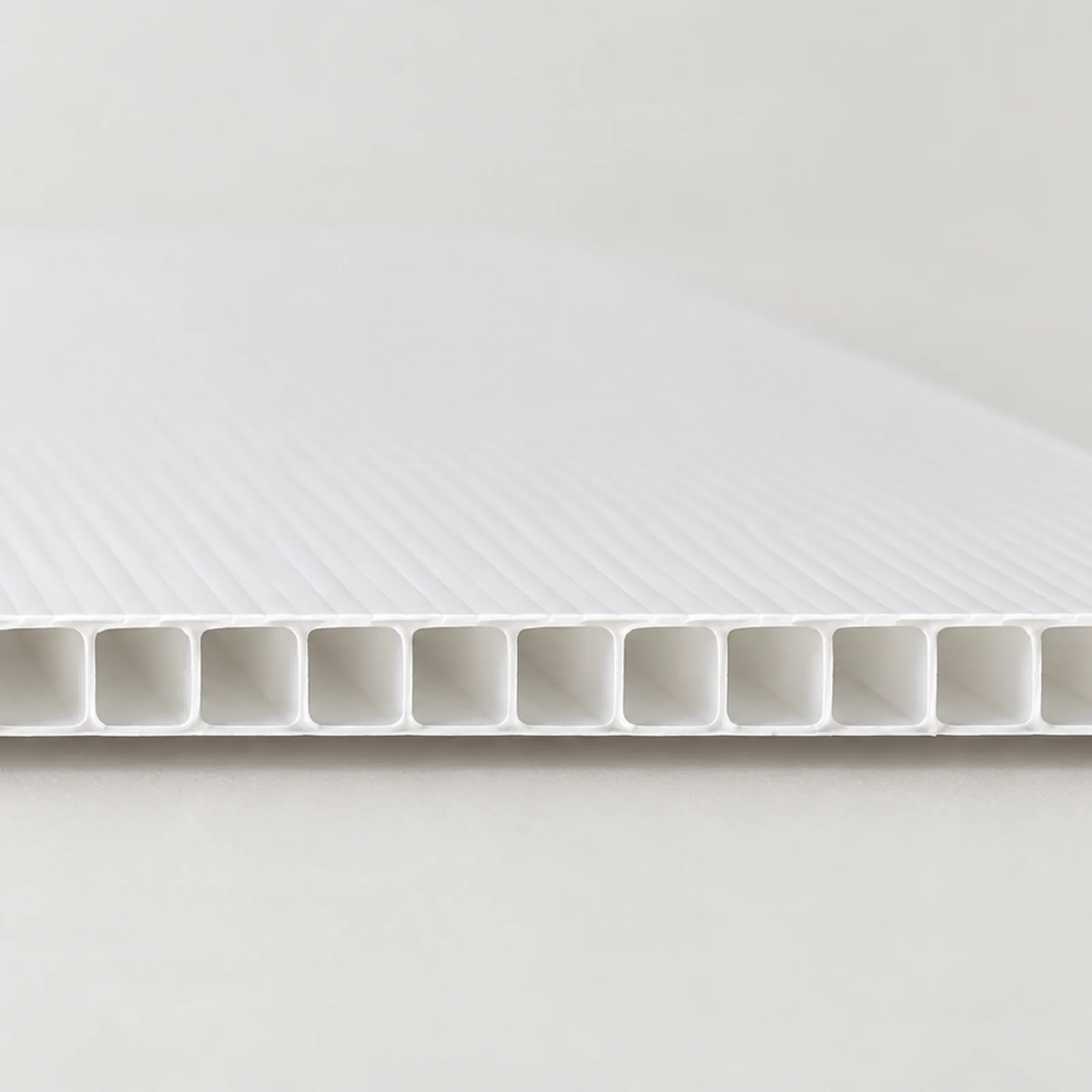
SPC board is a thin twin-wall packaging sheet. Two thin skins are joined by closely spaced internal ribs, leaving hollow rectangular channels along the extrusion direction. It is light relative to its width, and the cut edge shows the channels.
- Thin outer and inner skins
- Closely spaced internal ribs
- Hollow channels along the extrusion direction
- Low thickness relative to width
- Clean extruded cut edge
- Packaging-grade appearance
From compound to packaging
A process model at the level a buyer needs.
- Compounding
- Board extrusion
- Surface preparation and printing
- Cutting and die-cutting
- Punching
- Welding or assembly
- Finished packaging
SPC packaging vs corrugated cartons
A comparison against a specific corrugated carton for the same packaging job. Results differ with box grade, construction and the operating environment — a comparison is only meaningful for the same size, load and stacking task.
| SPC hollow board packaging | Corrugated carton | |
|---|---|---|
| Material and structure | Mineral-filled polymer composite; thin twin-wall hollow board with internal ribs. | Paper-based corrugated board, fluted core between liners. |
| Moisture and water contact | Board itself is not paper-based; behaviour under sustained moisture is application-dependent and validated per project. | Strength typically falls when wet unless coated or waxed; performance depends on board grade and coating. |
| Compression and stacking | Developed per application — rib direction, board thickness and box construction around the load. Specific stacking results need testing. | Well-documented box compression test (BCT) values; stacking is standard practice with defined limits. |
| Repeated handling and reuse | Structures can be developed for more than one trip; verified reuse counts are application-specific. | Usually single-trip; reuse is limited unless specially treated. |
| Printing | Basic colour printing for identification and branding. | Flexo and litho printing widely available at various quality levels. |
| Folding, closing and packing speed | Welded or assembled structures; packing speed depends on the box construction chosen. | Fast erecting and closing with standard machinery and tapes. |
| Customisation | Die-cut, punched and assembled into different structures from one sheet. | Highly customisable at scale with mature tooling. |
| Purchase and logistics cost | Depends on board weight, box structure and order size; evaluated per project against the target box. | Established supply chain with transparent pricing by grade and volume. |
| End-of-life path | Recyclable polymer stream; take-back and recovery arrangements confirmed per project. | Established paper recycling stream in most markets. |
Compared for the same effective inner size, single box load, stacking and transport route.
A comparison is only meaningful for the same packaging job. We do not claim SPC packaging replaces corrugated cartons in every application, is stronger in all conditions, or is always cheaper — material, structure and purchase conditions decide the result.
Where it can be used
SPC packaging is developed for a small number of demanding applications.
What SPC does not mean
Not flooring
SPC here is not Stone Plastic Composite flooring, laminate or any solid decorative panel.
Not a solid board
The packaging sheet is hollow and thin, not a thick solid core.
Not a fusion of stone and plastic
Mineral particles are dispersed in a polymer matrix; nothing melts into a single molecule.
Not a certification
SPC is a material description, not a compliance or performance claim.
Frequently asked questions
- What does SPC stand for?
- Stone Polymer Composite — a mineral-filled polymer composite material developed for packaging.
- Is SPC packaging the same as SPC flooring?
- No. The abbreviation is shared, the products are not. CSBX uses SPC only for packaging material.
- How does SPC become packaging?
- The compound is extruded into thin hollow board, which is printed, cut, die-cut, punched and welded or assembled into box structures.
- Are the ingredients published?
- The material concept is. Formulation ratios, additive systems and process parameters are not.
See the board in your own hands
A sample says more than a definition. Send us the box you use today.